Your Next Chapter Starts Here

The Role of Trade-Offs in Recruitment Decisions
4/15/20263 min read
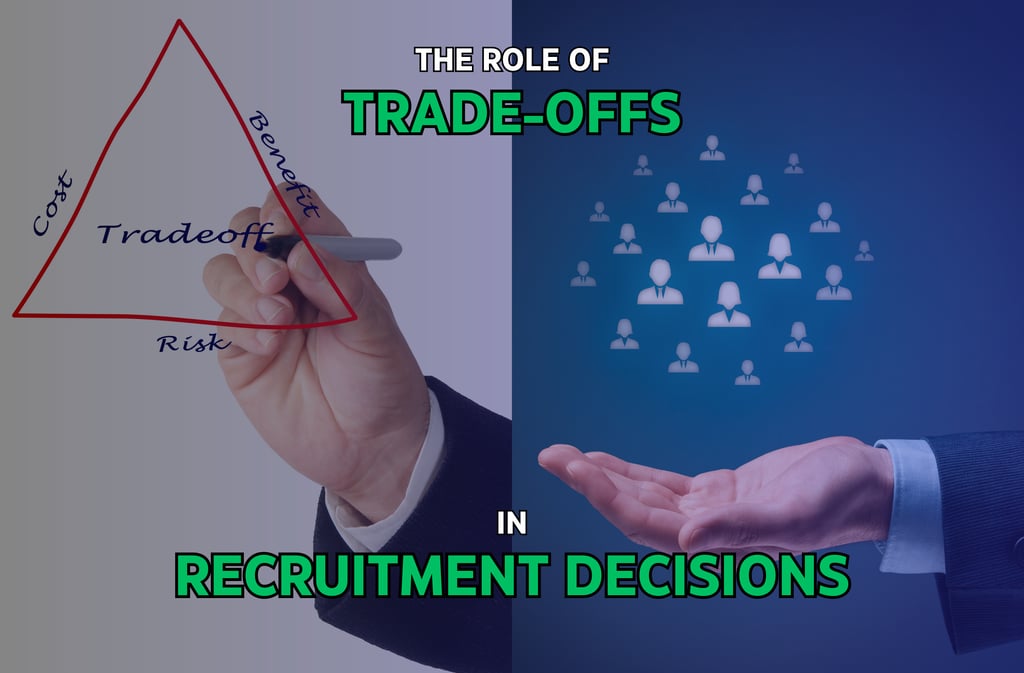
Recruitment decisions are rarely as straightforward as they appear. On paper, organisations often aim to identify the “best” candidate for a role. In practice, however, hiring is rarely about finding perfection. It is about weighing trade-offs — balancing strengths against gaps, experience against potential, and immediate impact against long-term growth.
Yet trade-offs are seldom discussed openly in recruitment conversations. Teams may hesitate to acknowledge them, preferring instead to search for an ideal candidate who meets every expectation. In reality, the ability to recognise and manage trade-offs thoughtfully is one of the most important capabilities in effective hiring.
Understanding the Nature of Hiring Trade-Offs
Every role contains multiple dimensions: technical expertise, leadership capability, communication style, cultural alignment, and potential for development. It is rare for any single candidate to excel equally across all of them.
Trade-offs emerge when organisations decide which qualities matter most for the role at this particular moment. A business entering a phase of rapid growth may prioritise speed of execution over long-term strategic thinking. Another organisation facing structural change may value adaptability and resilience more than deep technical specialisation.
These choices are not compromises in the negative sense. They are reflections of organisational priorities. Recognising this allows hiring teams to approach decisions with greater clarity and realism.
Why Trade-Offs Are Often Avoided
Many hiring teams find trade-offs uncomfortable to discuss. There is often an assumption that acknowledging limitations in a candidate may weaken confidence in the decision. As a result, conversations sometimes focus only on strengths, leaving the real decision factors unspoken.
This avoidance can create several challenges. Teams may struggle to articulate why a candidate was selected. Expectations may remain unclear once the individual joins the organisation. And when difficulties arise later, it can appear as though the hiring decision itself was flawed.
Openly discussing trade-offs helps prevent these issues. It ensures that decisions are grounded in shared understanding rather than unspoken assumptions.
The Value of Explicit Trade-Off Discussions
When hiring teams explicitly address trade-offs, decision-making becomes more structured and transparent. Rather than debating abstract impressions, teams can focus on practical questions:
Which strengths will create the greatest impact in the role?
Which gaps can realistically be supported or developed?
Which limitations would create unacceptable risk?
These discussions encourage thoughtful judgement rather than instinctive preference. They also help ensure that all stakeholders share a common understanding of the decision.
Importantly, acknowledging trade-offs allows organisations to enter the employment relationship with realistic expectations. Both the organisation and the new hire understand where strengths lie and where support may be required.
Aligning Trade-Offs With Organisational Context
The relevance of any trade-off depends on context. A capability that is essential in one organisation may be less critical in another.
For example, a candidate who excels at building new systems may be ideal for a business undergoing transformation. The same candidate might struggle in a highly structured environment where stability and operational continuity are the priority.
Recruitment decisions therefore need to reflect not only the role description but also the broader organisational environment. Understanding context helps hiring teams evaluate trade-offs more effectively and select candidates whose strengths align with current needs.
Supporting Better Candidate Conversations
Clear awareness of trade-offs can also improve communication with candidates. Instead of presenting the role as a perfect fit, recruiters and hiring managers can have more open discussions about expectations.
This transparency often strengthens trust. Candidates appreciate understanding both the opportunities and the challenges within a role. It allows them to assess whether the position aligns with their own goals and capabilities.
When these conversations occur early, they reduce the likelihood of misalignment later. Both sides enter the relationship with a shared understanding of the role’s priorities.
Learning From Trade-Offs Over Time
Trade-offs also provide valuable insight for future hiring decisions. By reflecting on past choices, organisations can identify patterns in what has worked well and what has proven more difficult.
For instance, a company may discover that prioritising adaptability over technical depth has led to stronger long-term results. Alternatively, it may learn that certain roles require deeper experience than originally assumed.
Capturing these lessons helps refine future recruitment strategies and improves the organisation’s ability to make confident decisions.
Conclusion: Embracing the Reality of Hiring Decisions
Recruitment is often portrayed as a search for the perfect candidate, but in reality it is an exercise in judgement. Every hiring decision involves balancing competing priorities and accepting certain trade-offs.
Organisations that acknowledge this reality are better equipped to make thoughtful, confident choices. By discussing trade-offs openly, aligning them with organisational context, and learning from them over time, hiring teams can turn complexity into clarity.
In the end, effective recruitment is not about eliminating trade-offs — it is about understanding them well enough to choose wisely.
AMR Global
Global leaders trust our search and selection expertise.
Reach out to us on
+44 7709 869 000
AMR Global © 2025. All rights reserved.