Your Next Chapter Starts Here

The Rise of ‘Career Narrative’ in Recruitment
5/9/20263 min read
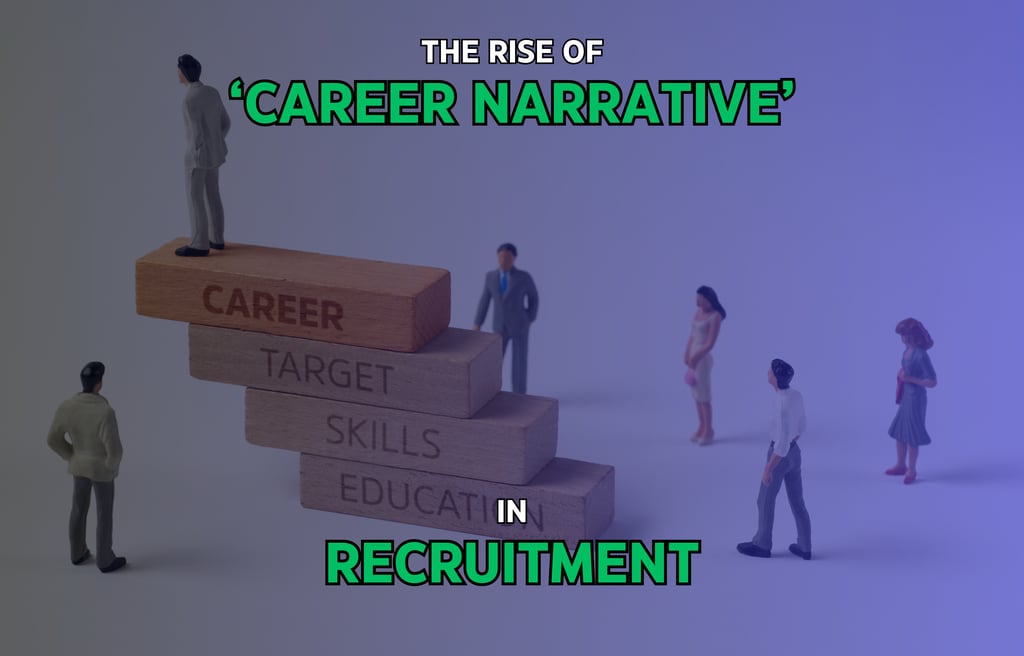
In today’s hiring landscape, CVs and job titles are no longer the primary lens through which candidates are understood. Increasingly, attention is shifting towards something more nuanced — a candidate’s career narrative. Not just where they have worked, but how their journey connects, evolves, and makes sense over time.
This shift reflects a broader change in how organisations interpret experience. Linear careers are becoming less common, and traditional progression is no longer the only marker of capability. As a result, recruitment is placing greater emphasis on how individuals articulate their story — not just the milestones within it.
From Chronology to Coherence
Historically, recruitment has relied heavily on chronology. A sequence of roles, promotions, and responsibilities provided a straightforward way to assess progression and fit. While this remains relevant, it is no longer sufficient on its own.
Career paths today are often less predictable. Individuals move across industries, take lateral steps, explore different functions, or pause and redirect their focus. What matters is not just the sequence, but the coherence behind it.
A strong career narrative explains:
why transitions were made
how experiences connect
what has been learned along the way
where the individual is heading next
This coherence helps hiring teams understand intention, not just history.
Why Narrative Matters in Modern Hiring
As roles become more fluid and organisations evolve more quickly, the ability to interpret non-linear careers becomes increasingly important. Candidates may not fit traditional patterns, but they may bring valuable perspectives shaped by varied experiences.
Career narrative provides context. It allows hiring teams to see beyond isolated roles and understand how different experiences contribute to a broader capability. It also helps distinguish between random movement and purposeful development.
For candidates, the ability to articulate this narrative is becoming a key differentiator. It demonstrates self-awareness, clarity of direction, and the ability to connect past experience with future contribution.
Reducing Misinterpretation of Non-Linear Paths
Without a clear narrative, non-linear careers can be misunderstood. Moves may appear inconsistent, gaps may raise unnecessary questions, and transitions may be seen as lack of focus rather than deliberate choice.
When narrative is present, these same elements can be reframed:
a lateral move becomes a strategic skill-building step
a change in industry becomes an expansion of perspective
a pause becomes a period of reflection or development
The difference lies not in the experience itself, but in how it is understood.
Recruitment processes that recognise this are better equipped to evaluate candidates fairly and accurately.
The Role of Recruiters in Interpreting Narrative
Recruiters play an important role in bridging the gap between experience and interpretation. They are often the first to hear a candidate’s story in full, and they have the opportunity to shape how that story is communicated to hiring teams.
This involves more than summarising a CV. It requires:
identifying the underlying themes in a candidate’s career
understanding the motivations behind key decisions
presenting experience in a way that aligns with the role’s context
When done well, this helps hiring managers engage with the candidate’s potential more fully, rather than focusing only on surface-level details.
Balancing Narrative With Evidence
While career narrative is valuable, it does not replace the need for evidence. Experience still needs to be assessed, and outcomes still need to be understood.
The goal is balance. Narrative provides context, while evidence provides validation. Together, they create a more complete picture of the candidate.
Relying on one without the other can lead to incomplete judgement. Narrative without evidence can feel ungrounded, while evidence without narrative can feel disconnected.
Strong recruitment processes integrate both.
What This Means for Organisations
For organisations, the rise of career narrative requires a shift in perspective. Rather than looking for perfect alignment with predefined paths, hiring teams need to be open to different forms of progression.
This may involve:
asking more reflective questions during interviews
focusing on reasoning and decision-making, not just outcomes
recognising transferable experience across different contexts
It also requires a willingness to move beyond rigid expectations and engage with the individual behind the CV.
Conclusion: Understanding the Story Behind the CV
Recruitment is evolving from a process of matching profiles to one of understanding people more fully. Career narrative plays a central role in this shift. It brings coherence to complexity and helps organisations see potential in places they might previously have overlooked.
In a market where careers are less linear and more dynamic, the ability to understand and interpret narrative is becoming a defining capability. It allows hiring decisions to move beyond surface-level alignment and towards a deeper, more meaningful understanding of what candidates can truly offer.
AMR Global
Global leaders trust our search and selection expertise.
Reach out to us on
+44 7709 869 000
AMR Global © 2025. All rights reserved.